


Digital Sovereignty for Musicians
Get behind the controls of your own feed!
Your Music, Your Rules.
We don't sell anything. We only offer the knowledge and tools you need to reclaim your digital independence.
The current music industry is built on walled gardens. Platforms like Spotify and Instagram keep your fans captive behind algorithms and commissions. ReGlobe Music is here to show you how to break down those walls.
The Basics: Digital Sovereignty
True ownership of your work rests on three pillars:
Your Own Website: Your digital headquarters. The only piece of the internet that's truly yours.
Self-Hosting: Store your audio files where you want, not where a platform dictates.
RSS Protocol: Use this open protocol to send your music directly to your listeners. No algorithms determine who you reach.
How We Support You
ReGlobe Music functions solely as a knowledge hub. You'll find here:
Manuals: Step-by-step explanations on how to use technologies like MusicSideProject to manage your own RSS feed.
Network: References to open-source technologies like the Podcast Index, Nostr, and IPFS.
Direct Payments: Explanations on how to integrate payment links (like Patreon or Bitcoin Lightning) directly into your own feed, ensuring 100% of the support goes to you.
Why We Do This
We believe in a fair music industry without gatekeepers. We use platforms like Wavlake ourselves because they were pioneers in this open technology, but the ultimate goal is that you, as an artist, no longer need anyone but your band, mates, family and fans.
1. What is RSS and why is it essential for my band?
RSS (Really Simple Syndication) is an open protocol. It allows you to send updates and music directly to your listeners without an algorithm or platform in between. If you have an RSS feed, you own the connection to your fans. No platform can sever that connection or place it 'behind a paywall'.n feed!
2. Why don't major social media platforms support this protocol?
Social media platforms (such as Facebook, Instagram and Spotify) are 'walled gardens'. Their business model is based on keeping users within their own walls to collect data and sell advertisements. An open protocol like RSS makes their platform obsolete because it allows the user to consume the content where they want. Therefore, it is actively avoided or blocked.
3. Why do I need my own website and hosting?
As soon as you post your music exclusively on a platform, you are a renter. The landlord (the platform) can change the rules, fees and your visibility at any time. With your own website and good hosting you are the owner. Your website is the source of your RSS feed; it is your digital headquarters that cannot be censored.
4. How do I get my music to the listener without an intermediary?
The process is technically simple and gives you complete control:
Upload your MP3s: Tell your IT wizard that you want your album on your own hosting, preferably via CDN
Create a feed: Use MusicSideProject.com to generate an RSS feed of your music. Click here to go directly to a Tutorial on this site about MSP RSS feed generation
Publish: Upload this feed to PodcastIndex.org.
Result: Your music can be found immediately in all modern 'Podcasting 2.0' apps and RSS readers, without having to pay a distributor or label for access.
5. Is my content publication separate from my payments?
Yes, and that is a crucial advantage. In the old model, the platform (e.g. Spotify) determines how you get paid. In the V4V model, publication (via RSS) is separated from payment:
Publication: The music files are on your own host.
Payment: In the metadata of your RSS feed is optional. You link directly to payment methods of your choice. This can range from traditional platforms like Patreon to direct Bitcoin Lightning payments.
6. Why should I use Bitcoin and the Lightning Network?
Bitcoin (via the Lightning network) makes 'Value4Value' possible: listeners can send small amounts (micropayments) per second while listening directly to your wallet and to those of all other rights holders such as your band members, songwriter, etc. There is no bank or credit card company that withholds a percentage or can block the transaction. It is the purest form of direct support.
If you have any objections to Bitcoin, there are currently no alternatives that allow direct a la minute payment. or streaming micro-payments. So encourage your favorite dev to add your favorite 'way' to the RSS spec.
7. Why do GG Deluxe and FilanysZ themselves use wavlake.com?
Wavlake was the first party to make the complex technology behind Podcasting 2.0 and Lightning payments accessible to musicians. against a 10% take on incoming lightning payments. We use and promote Wavlake to support these pioneers and show what is possible. It serves as a powerful example of how to build a user-friendly interface on an open protocol.
It is also fortunate that Wavlake operates as a semi-walled garden. their catalog of music is public and can be found in all other podcast 2.0 apps with full functionality.
But not back proportionately. so there are advantages and disadvantages. At the time of writing, several apps are working to add these functions to their system, such as Fountain.fm, which charges 5 dollars per month. But is working on more extensive features such as analytics and overall guidance and lightning wallets included.
Most bands already have monthly costs for web hosting in that region and since the technology was born from a D.I.Y. attitude, we now mainly promote doing it yourself!
What is Value4Value?
Value4Value (V4V): The Model
Definition Value4Value is a distribution and revenue model based on direct interaction between content creator and buyer. Unlike traditional advertising or subscription models, V4V relies on voluntary contributions after the fact.
The Three Pillars of Contribution (Producers) Listeners and fans contribute as 'producers' through three methods:
Time: Paying attention to the content.
Talent: Using skills (such as coding, design or promotion) to improve the project.
Treasure: Financial support, usually in the form of micropayments.
Technology and Implementation The model uses open protocols and decentralized networks:
Podcasting 2.0: The technical standard that integrates V4V into RSS feeds.
Nostr: A protocol for censored communications using 'zaps' (instant payments).
Bitcoin/Lightning: Used as sound money for frictionless, instant transactions without the involvement of banks or payment processors.
Features
Censorship-resistant: No central authority can block the content or the flow of money.
Ownership: Creators retain full control over their distribution channels.
Transparency: Direct settlement between sender and receiver without intermediaries.


Join the movement
Be empowered
And Do it Yourself!
with a little help from your Friends!
It's like busking on the web, with optional anonymity
Tutorial: Independent RSS distribution via MSP (Route: Own Management)
Goal: Generate a Podcasting 2.0 compliant RSS feed while retaining 100% ownership of the feed URL.
1. Input and Configuration
Create project: Go to MusicSideProject.com and create a new artist profile or album.
Metadata: Complete the required fields (Title, Description, Artwork at least 1400x1400px).
Tracks: Upload the audio files. These act as the source for the metadata (duration, file size) that will appear in the feed.
2. The Value Layer (Payments)
Lightning Address: Enter your own Lightning address (e.g. from your Umbrel node or Alby) to receive direct payments.
Value Splits: Set the split between band members or producers. This is processed directly in the XML code.
3. The Export: Ownership over Convenience
Instead of having the feed hosted by MSP, choose maximum sovereignty when storing:
Download XML: Choose this option to download the generated RSS file as an .xml file to your computer.
Alternative - Copy to Clipboard: Use this option if you want to paste the code directly into a text editor on your own server.
Result: You are now no longer dependent on the servers of MSP or other 3rd party for the availability of your feed.
4. Implementation on your own domain
Upload: Place the downloaded .xml file on your own web hosting (e.g. via FTP to example.nl/jouwband/feed.xml). make sure this is a regular spot! This link to your RSS feed is essential for finding your music through podcast and music apps
Audio URLs: Verify that the audio links in the XML point to your desired location on your own server for complete control.
5. Validation and Publication
Register: Copy the URL of your RSS feed from your own domain
Podcast Index: Go to PodcastIndex.org and add your own URL.
Result: Your music can now be found in all V4V apps, with your own website being the official source (source of truth).


Here is a rather lenghty and still somewhat confusing overview video by chadF of the rss feed generator 2.0 . This is a retooling of the original MSP by StevenB
And in his own words: "Do It Yourself with Music Side Project
But, you're musicians, you're used to booking your own gigs, hauling your own gear, selling your own merch, and sorting your own brown M&Ms. You should be hosting your own feed. And that's where Music Side Project comes in. It's a tool that helps you to build your feed. You could open a text document and copy and paste all of your own links into a RSS file, and it would work. In fact, Spencer Pearson has created a template feed for just that, and it gives you the ultimate control. Music Side Project holds your hand a little more. It gives you a slick interface to copy and paste your info, and then automatically creates your RSS file to host on your own server. Then all you have to do is let the Podcast Index know where it can find your feed, and next thing you know, you have a published album your fans can listen to,"
i promise i will make my own tutorial video soon......
i promise i will make my own tutorial video soon......
Our Mission!
Independence for musicians
ReGlobe Music helps artists work outside the traditional music industry using open technology (Podcasting 2.0, Nostr, IPFS, blosom-server).
What we do:
Education: Explanation of open-source distribution and revenue models.
Technology: Assistance with setting up RSS feeds, registering with the Podcast Index, and setting up direct payments (Value Splits).
Community: Connecting independent creators.
The goal:
Ownership: You retain full control over your own music and distribution.
Fair income: Direct payments to fans through the Value4Value model, without the intervention of platforms.
Independence: Building a sustainable career without reliance on algorithms or labels.

Contact Us
Connect with us!
Check out our Friends!
'We're UnCommonRadio; we're Ray, Luca and Michel. We started an Internet Radio Station of sorts to be able to play songs by relatively unknown artists, usually beginning artists, both local and from further away.'
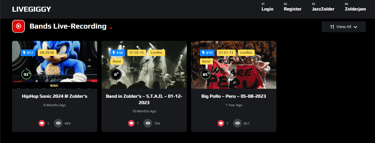
'LiveGiggy aims to be a streaming site for live music & musicians in general.'
'Wavlake is a platform for musicians and podcasters to publish and distribute their creative work on the open internet and receive bitcoin from anywhere for that work. When you publish a track on Wavlake, the audio is accessible from any application that can read open protocols such as Podcasting 2.0 (RSS) and Nostr. Every track you publish also is capable of receiving bitcoin micropayments via the Lightning Network. This means that your music or podcast is free to access from anywhere, but it’s also able to earn from anywhere.'
'Alby is a Bitcoin & Nostr companion for the web. It allows users to connect their wallet, use Bitcoin & Nostr apps with the Alby Extension. Users can create an Alby Account to get a lightning wallet for payments. Alby aims to make interacting with the world of bitcoin apps seamless.'